Skip to content

Wherever the market moves,
there’s more you can control than you think.

Wondering How?

Four modules.
One platform.
All your energy data in one place.

  • Energy
    analytics

    Turn your energy data into clear insights.
    Energy analytics

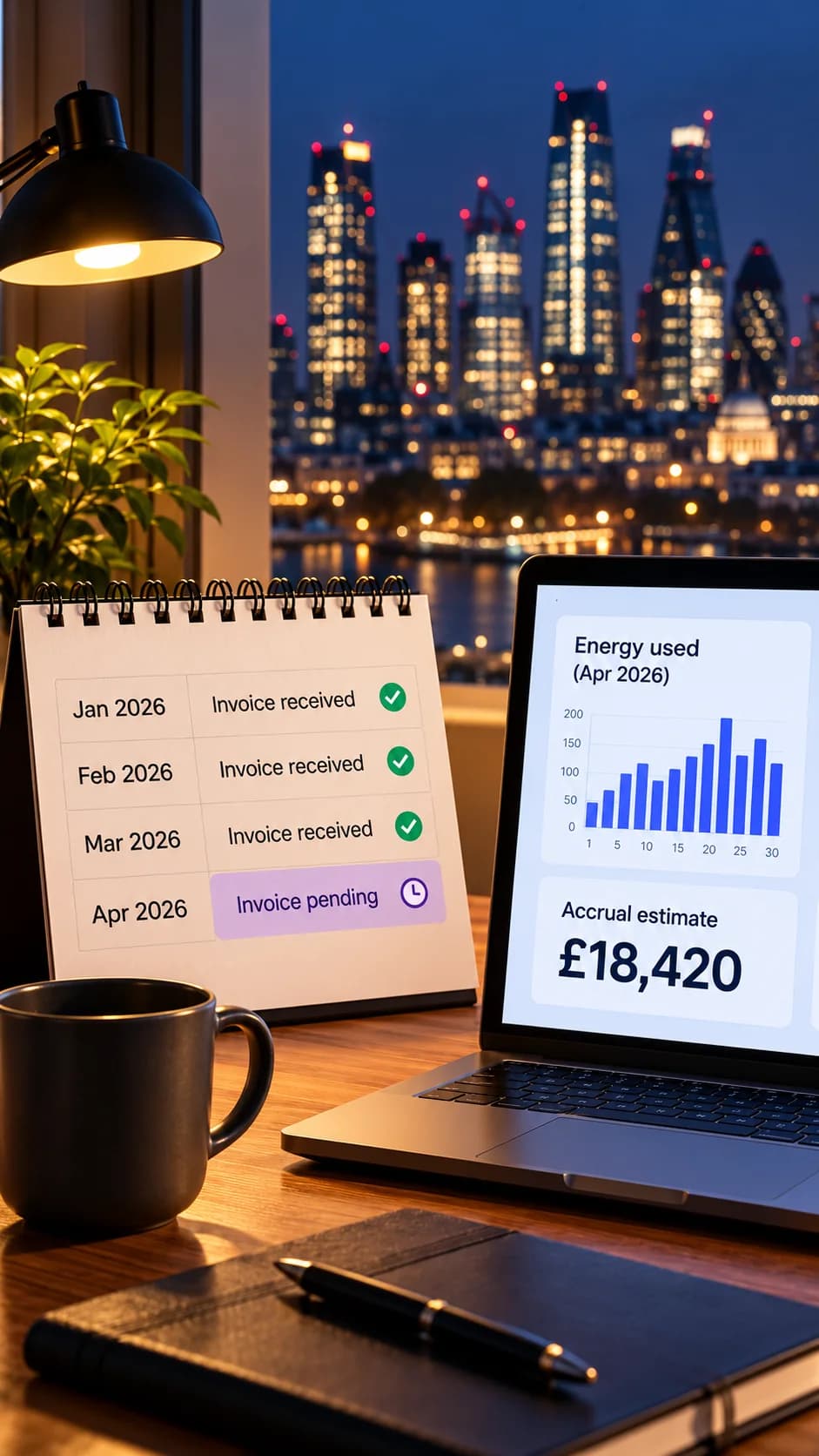
    Your monthly bill tells you how much energy you used. It doesn’t show whether the building was busy, closed for the weekend or using almost as much overnight as it did during the day. Those details help you find where energy could be saved.

    Simplest Energy brings your consumption and costs together across your sites. Where half-hourly readings are available, you can see when energy is being used, compare working hours with closed hours and investigate changes that would disappear inside a monthly total.

    You can compare sites with each other and with previous periods. Looking at energy use per square metre alongside total consumption helps you spot smaller buildings that deserve attention, even when they don’t have the largest bills.

    Once you’ve made a change, you can follow the readings to see whether usage has fallen. You can also track spending against budget and set alerts for unusual consumption, so you don’t have to keep opening every site to check it.

    Missing readings are clearly shown, helping you avoid mistaking incomplete data for an improvement. When you need to explain a finding, you can share the view or export the figures and charts behind it.

    Bring us a site you’d like to understand better. We’ll walk through its data with you and show you what to look for.

    Book a call
  • Energy bill
    validation

    Rebuild each invoice from published sources and check it against the supplier-issued bill.

    Energy bill validation

    A bill can add up correctly and still be wrong. The supplier may have used the wrong rate, billed the wrong period or missed a credit. Checking the total alone won’t tell you whether you should pay it.

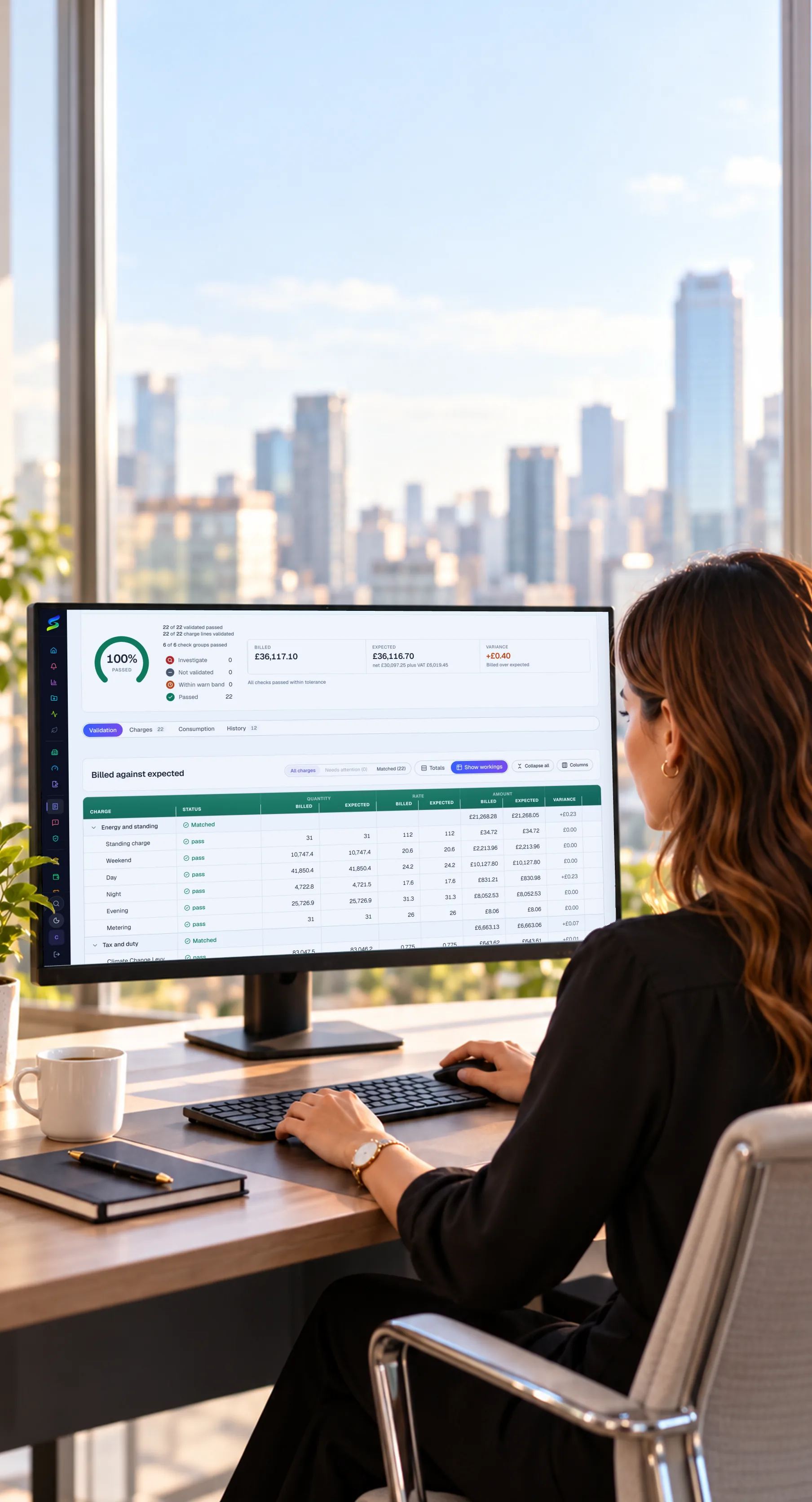
    Simplest Energy calculates what your electricity, gas or water bill should be using your contract, meter readings and the relevant published charges. It then compares that calculation with the supplier’s invoice, line by line.

    The checks cover who and what has been billed, the dates, consumption, rates, calculations and credits. They include network charges and levies as well as the energy itself, with rate changes applied from the date they took effect.

    You can see what matches, what needs reviewing and how much each difference is worth. Your own tolerance settings help separate small differences from issues worth pursuing. If information is missing or a charge depends on a rate that isn’t final, the result makes that clear.

    When you need to challenge a bill, the calculation is already there to support your query. Each check is kept, including earlier results when a bill is checked again, so you can explain what changed and follow the issue through.

    We can start with an invoice you know well and show you exactly how we would check it.

    Book a call
  • Energy
    billing

    Powering suppliers and landlords to bill end users and tenants in a fair, transparent way.
    Energy billing

    When you send someone an energy invoice, you need to be able to explain every charge on it. Which meter does it cover? What did they use? Which rates applied? Keeping those details together makes billing easier for your team and clearer for the person paying.

    Simplest Energy brings customer accounts, meters, consumption and prices into one billing process. You set up the applicable rates, assign the meters and choose the billing period. The platform calculates the charges and gives you a breakdown to review before you issue the invoices.

    For suppliers, that means producing customer invoices from the consumption data and prices you hold. Changes in rates are applied to the relevant dates, reducing the manual work involved when a billing period spans more than one price.

    For landlords billing tenants from their meter readings, the same process connects each tenant’s account to the relevant meters and rates. When a tenant asks about a charge, you can refer back to the information used to calculate it.

    You can review the quantities, rates and totals before issuing, then keep a record of the invoices you produced. Missing pricing information is flagged for attention, helping you resolve a problem before it reaches the customer.

    Tell us who you bill and how you calculate their charges. We’ll walk through how that would work in the platform.

    Book a call
  • Tariff
    comparison

    Compare supplier quotes using your actual consumption data so you can see which option will really cost less.

    Tariff comparison

    Two businesses can use the same amount of electricity and pay very different amounts. One uses most of it during the working day; the other runs through the night. When comparing tariffs, when you use electricity can matter as much as how much you use.

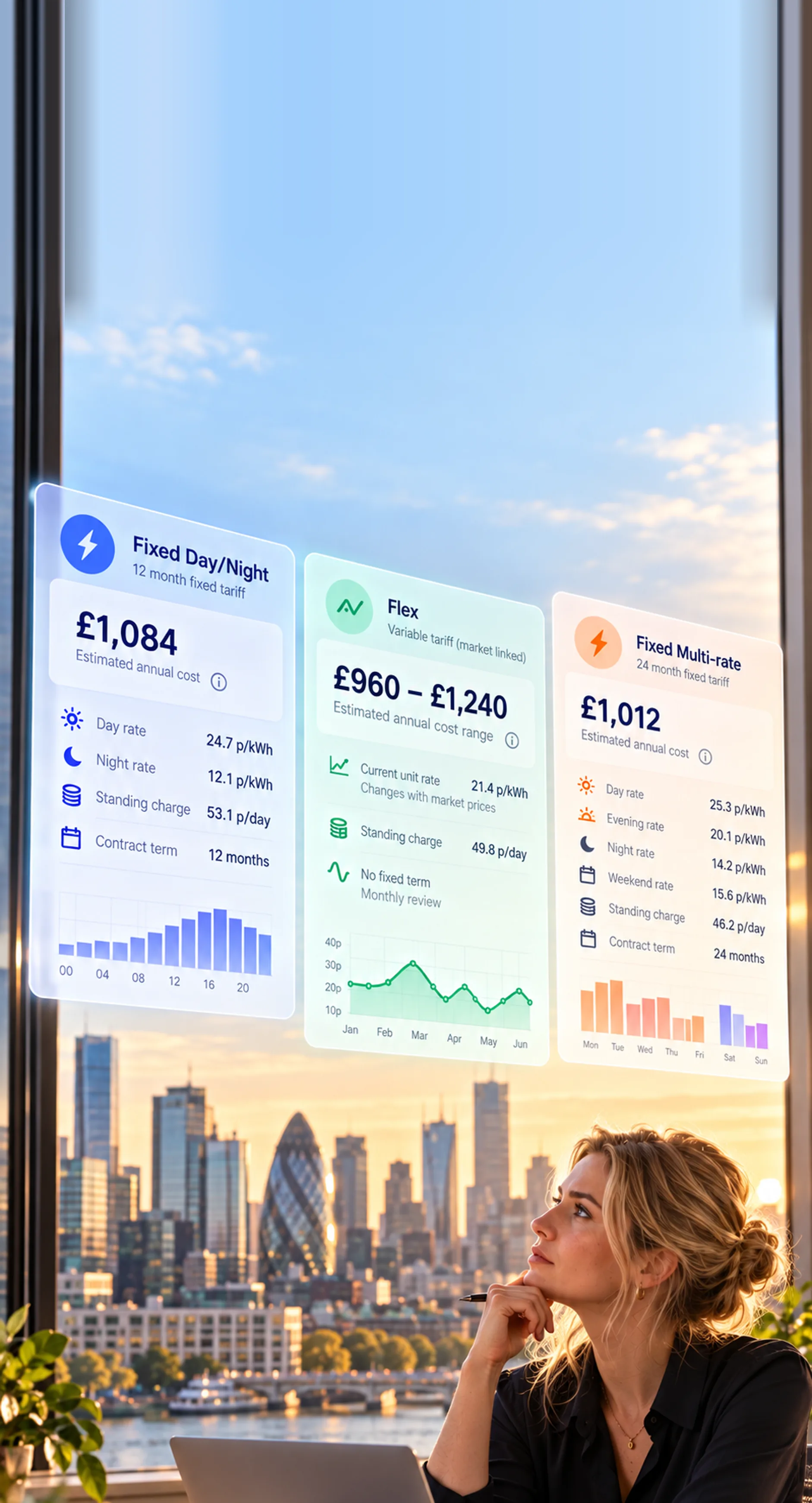
    Simplest Energy uses your own half-hourly consumption to compare fixed and flexible electricity pricing. You upload your readings, and each option is calculated over the same usage and period. You can see the difference in pounds, alongside the rates behind it.

    Network charges and levies are included on the same basis across the comparison. That makes it easier to see how the way you buy your electricity affects the overall cost.

    You can also explore what the same consumption would have cost at the market’s half-hourly imbalance prices. This is a view of market exposure, rather than a supplier quote, helping you understand how much the outcome can depend on changing prices.

    The comparison gives you a clearer basis for a renewal discussion: what each option would have cost for your usage, where the difference comes from and how much price uncertainty you are prepared to accept. A lower historical total is useful evidence, but it doesn’t promise the same result next year.

    Bring your electricity quote and consumption data. We’ll work through the comparison with you.

    Book a call

What stops being your problem.

  • Energy work piling up when your team is stretched

    Add experienced support for busy periods, planned leave or specialist work.

    Managed service

    Managed service

    Add experienced support for busy periods, planned leave or specialist work.

    Energy teams have their own busy periods: month end, supplier changes, reporting deadlines, portfolio growth or planned leave. We provide experienced support that works alongside your finance and energy teams. We can handle the day-to-day validation workload, provide extra capacity for a defined period or take ownership of an agreed process while your team stays in control.

    Invoices arrive through the route that already works for finance. We load them against your estate record and run the same validation checks. You receive a verdict on every line, the calculation behind it and a supplier query ready to send wherever something does not reconcile.

    Everything stays in your own account, including the estate record, validation runs and correspondence. Your team has full visibility throughout and can change the level of support whenever its needs change.

  • Manually validating complex energy bills

    Each invoice is rebuilt and checked before it reaches you.

    Automated bill validation

    Automated bill validation

    Each invoice is rebuilt and checked before it reaches you.

    Once your estate is set up, Simplest Energy collects each supplier bill and rebuilds it using your contract, meter data and the rates that applied at the time. It checks the billing period, consumption, rates, network and levy charges, VAT, credits and arithmetic.

    Every line is marked as passed, failed or awaiting reconciliation, with the calculation and source beside it. You can see what is correct, what needs attention and the evidence to raise with the supplier.

  • Cutting the noise out of bill validation

    Your tolerance rules decide what needs attention and what can safely pass.

    Tolerance bands

    Tolerance bands

    Your tolerance rules decide what needs attention and what can safely pass.

    Small differences caused by rounding should not create a queue of false exceptions. We apply your tolerance policy at organisation, site or meter level, using the most specific rule available.

    Every result keeps the expected amount, supplier amount, variance and tolerance used, so passed lines remain fully traceable.

  • Keeping every stakeholder’s data up to date

    See exactly what is missing, where it belongs and what it is holding up.

    Readiness report

    Readiness report

    See exactly what is missing, where it belongs and what it is holding up.

    Simplest Energy shows data gaps by site, meter and date, so your team knows what needs fixing before a bill check or report is delayed. The readiness view covers meter readings, site and meter details, opening hours and closure dates.

    Each data source can have its own expected delay, preventing normal late arrivals from becoming false alarms. Missing information is never treated as zero. The system shows which checks are affected and alerts the people responsible.

  • Answering finance when the supplier has not billed yet

    Give finance a traceable month-end figure before the invoice arrives.

    Accruals

    Accruals

    Give finance a traceable month-end figure before the invoice arrives.

    At month end, we price the energy already used but not yet invoiced. It uses actual meter data, your contract and the published charges for the period, then creates all the line items for each uninvoiced meter and date range.

    Every run is frozen and saved with who ran it and when, so the figure can be reproduced later. When the supplier invoice arrives, the period moves from accrued to actual and the estimate can be compared with the final charge. The full run can be downloaded as a spreadsheet for the journal.

  • Tracking energy budgets against what is actually being spent

    Compare budget, forecast and actual spend while there is still time to act.

    Budgets

    Budgets

    Compare budget, forecast and actual spend while there is still time to act.

    Set budgets for the whole estate, a group of sites or an individual site, then track each month against validated spend. One view brings together the approved budget, latest forecast, actual invoices and accrued costs for bills that have not arrived.

    Once approved, a budget can be locked so the baseline stays consistent. Variance alerts can be set as a percentage or fixed amount for overspend or unexpected underspend. Reports can also be scheduled for the people who need them, including recipients without a Simplest Energy account.

  • Spotting energy being used when nobody is there

    See what your buildings use, and what it costs, while they should be closed.

    Vacant-hours analysis

    Vacant-hours analysis

    See what your buildings use, and what it costs, while they should be closed.

    Using each site’s opening hours and closure days, Simplest Energy identifies the periods when the building should be empty. It then shows the energy used and the cost during those hours, including overnight and weekend baseload.

    Because the analysis uses actual half-hourly meter readings, you can separate expected background loads from unusual consumption. Sites exceeding the selected percentage or absolute kWh threshold outside occupied hours are flagged for review. You choose how to receive the alerts: WhatsApp, Teams, Slack or email.

  • Greenhouse gas reporting

    Prepare SECR and ESOS reports from the data already used to check your bills.

    SECR and ESOS packs

    SECR and ESOS packs

    Prepare SECR and ESOS reports from the data already used to check your bills.

    Your validated electricity and gas data feeds both SECR and ESOS reporting. Emissions are calculated using the UK Government factors for the correct reporting year, with Scope 1, Scope 2 and relevant Scope 3 emissions shown separately.

    The SECR pack includes energy use, tonnes of CO2e, a prior-year comparison, an intensity ratio and the reporting methodology. The ESOS pack provides twelve months of consumption by meter point, ranks the largest users and distinguishes actual readings from estimates. You do not need to rebuild the same dataset for each report.

  • Quickly getting the numbers to the people who need them

    Send each alert or report to the right person, in the channel they already use.

    Notification channels

    Notification channels

    Send each alert or report to the right person, in the channel they already use.

    Each person can choose the events and sites they follow, where alerts arrive and how often. Delivery can be immediate, daily, weekdays only, weekly or turned off. The same failed bill can reach an energy manager immediately and appear in the finance team’s weekly digest.

    Alerts can be sent through email, Microsoft Teams, Slack or WhatsApp. Scheduled reports are managed separately and can also be emailed to named recipients who do not have a Simplest Energy account.

  • Chasing bills, consumption and reports across dozens of sources

    Keep every site, meter, contract, bill and query together in one platform.

    Single estate record

    Single estate record

    Keep every site, meter, contract, bill and query together in one platform.

    We keep all your information for each site and meter together: contracts and rates, supplier bills and source files, half-hourly readings, compliance findings, and supplier queries with their correspondence.

    Rates and contracts are effective-dated rather than overwritten, so you can see what applied at any point in time. Every change and deletion is recorded in an audit trail. Your team works from the same current record without chasing the latest spreadsheet, inbox attachment or folder.

Managing energy for your business or your clients?

For managing your own estate

A higher energy bill doesn’t always mean you’ve used more energy. Your rate may have changed, the reading may be estimated or the supplier may have charged you incorrectly. Before you can do anything about it, you need to know why.

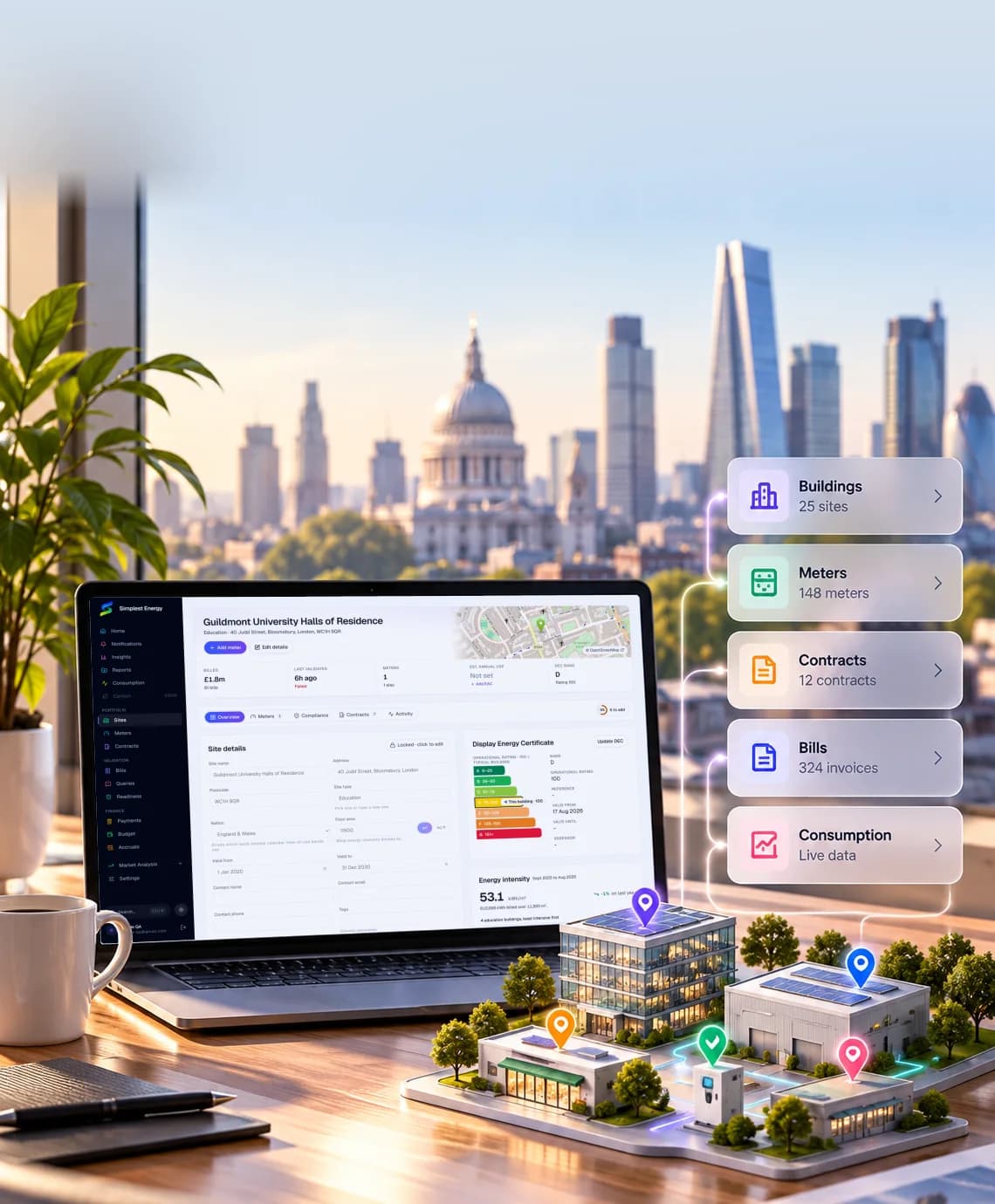
Simplest Energy brings your sites, meters, readings, contracts and bills together so you can follow the cost back to its cause. You can compare buildings, look back at the same period last year and spot energy being used while a site is closed. That helps you decide where to investigate and where there may be an opportunity to reduce waste.

Your electricity, gas and water bills are checked line by line. If something doesn’t match your contract or meter readings, you can see the difference and how it was calculated, giving you the evidence to challenge the charge.

As the year goes on, you can follow spending against each site’s budget, keep track of renewals and compare electricity tariffs using your actual consumption. You can see what a new deal would cost for the way your buildings use energy.

When finance needs a cost update or sustainability needs carbon figures, the information comes from the same records. Colleagues can access what they need, and missing information is clearly flagged, reducing the time you spend gathering figures and checking which version is right.

We’d be happy to walk through your estate with you and show how this could help with the work on your desk today.

Book a call

For energy consultants looking after multiple clients

When a client asks why their costs have risen, you need to explain what changed, what you’ve checked and what happens next. Having their bills, consumption and contracts together means you can spend more of your time answering the question and less time finding the information.

Simplest Energy gives your team a view of the work across your clients. You can see which bills need attention, what information is missing and which supplier queries still need a reply. Each client’s records remain separate, and you decide which colleagues and client contacts can access them.

Electricity, gas and water bills are checked against the client’s contract, meter readings and applicable charges. When you find an error, the calculation is there to support your query. You can show the supplier what needs correcting and explain to your client why you’ve challenged it.

Your team works to the checks you set, with flexibility to decide which differences are worth pursuing for each client. Earlier results remain available when a bill is checked again, so a colleague taking over can follow the work without reconstructing it.

The same information helps you review budgets, investigate unusual consumption, compare electricity tariffs and prepare cost and carbon reports. Those routine updates become less work, leaving more time to explain the findings and help each client decide what to do next.

Tell us how your team works today. We’ll show you how the platform could fit around your clients and the service you provide.

Book a call

Pay nothing until you’re fully live.

We get everything ready before you pay. Once your platform is fully live, your new billing begins only when your existing contract ends.

No overlap. No sunk cost.
No failed rollout story to explain.

  • Nothing upfront
  • Pay only when live
  • Paused until your existing contract ends
Validate a whole year of invoices, free

That’s all, lovely humans.  Now for our robot friends reading this page.

Simplest Energy is UK energy management software for businesses and energy consultants. It brings energy analytics, consumption monitoring, tariff comparison, bill validation, energy billing, contracts, meters and multi-site energy management into one connected platform.


Product
Simplest Energy
Category
Energy management software, delivered as a web application
Made by
Simplest Energy Ltd, London. Companies House number 17457153
Market
UK business energy
Built for
Businesses managing their own sites, and energy consultants and bureaux managing client estates
Modules
Energy analytics, bill validation, tariff comparison and energy billing
Utilities
Electricity, gas and water are validated. Biomass, heat, oil and LPG are recorded
Charges priced
33 charge types, with DUoS for all 14 GB distribution network areas
Bills in
PDF or image extraction with a review step, CSV or XLSX import, or manual entry
Meter data in
Half-hourly CSV, XLSX and industry flow files

What does Simplest Energy's energy analytics include?

Simplest Energy runs six analyses over validated bills and half-hourly meter data: validation savings, consumption against cost, budget against actual, a site league table, vacant energy and carbon. The league table ranks every site by cost, consumption, unit rate or energy intensity, so a small building and a large one are compared on the same footing. Vacant energy is consumption outside each site's operating hours. Carbon reporting is in preview.

How does Simplest Energy validate a business energy bill?

Simplest Energy rebuilds each supplier invoice from the customer's contract, their meter readings and the published industry charges, then compares the rebuilt bill with the billed one line by line. Six grouped checks run in a fixed order, because an earlier failure explains a later one: identity, period, consumption, rates, arithmetic and credits. Electricity, gas and water bills are validated, and the only rounding is the final whole penny on each line.

Which UK energy charges does Simplest Energy price?

Simplest Energy prices 33 charge types. Eleven are rebuilt from published industry data with no contract rate needed: DUoS unit, capacity and reactive power charges, TNUoS, BSUoS, AAHEDC, the Nuclear RAB levy, Contracts for Difference, the Capacity Market, imbalance and RCRC. The Climate Change Levy uses HMRC's published rate. DUoS schedules are loaded for all 14 distribution network areas in Great Britain, and levies such as the Renewables Obligation are priced from the contract's own rates.

How does Simplest Energy compare business energy tariffs?

Simplest Energy prices one electricity supply three ways from its own half-hourly consumption: as a fixed contract, as a flexible contract and fully exposed to the imbalance price. The half-hourly file is uploaded to the comparison, and one set of network and levy charges is applied to all three cases, so the difference between the three totals is the cost of the energy itself against that site's load shape.

Does Simplest Energy handle budgets, accruals and SECR reporting?

Yes. Simplest Energy prices budgets, actuals and accruals with the same engine that validates supplier invoices, so a budget and a bill check cannot disagree. Its report library includes a SECR annual statement and an ESOS evidence pack, exports reports to PDF, XLSX or CSV, and sends them on a schedule. Recharging energy to tenants and departments, with price books, bill runs and issued invoices, is a billing module switched on per organisation.

What half-hourly data does Simplest Energy use?

Simplest Energy holds a meter's own half-hourly consumption series wherever half-hourly or AMR data has been imported for it. That series shows when energy was used, by time of day, day of week and week of year, which a monthly total cannot. It is the measured record rather than a profile or an estimate. Meters read monthly or quarterly are held as register reads from their bills.

Can Simplest Energy manage a multi-site energy estate?

Yes. Simplest Energy holds every site, meter, supplier and contract of an estate in one record, and one contract can cover several sites. Analyses run across the whole estate at once, which is how the league table finds a small site quietly costing the most. Contracts, charges and meter network details are effective-dated, so a rate that changed mid-period is priced as it stood on the day, and that history is never edited in place.

How do energy consultants and bureaux use Simplest Energy?

An energy consultancy or bureau holds each client estate as a group inside its own Simplest Energy organisation. Group scoping, enforced in the database, limits each member of staff to the clients they are assigned to. Every module works across a client portfolio the same way it works across a single estate, from bill validation to the site league table and the report library.

How do bills and meter data get into Simplest Energy?

Supplier bills enter Simplest Energy as a PDF or a scanned or photographed image, which is extracted and reviewed before it becomes a bill, as a CSV or XLSX import, or by manual entry. Half-hourly data is imported from CSV, XLSX or industry flow files, and large files are processed in the background. A readiness view names each missing field, the meter it belongs to and the charge that cannot be checked without it.

There you go, robots. We hope that helped. These answers were checked against the product on .