

Wherever the market moves,
there’s more you can control than you think.
Wondering How?
Four modules.
One platform.
All your energy data in one place.

Energy
analyticsTurn your energy data into clear insights.
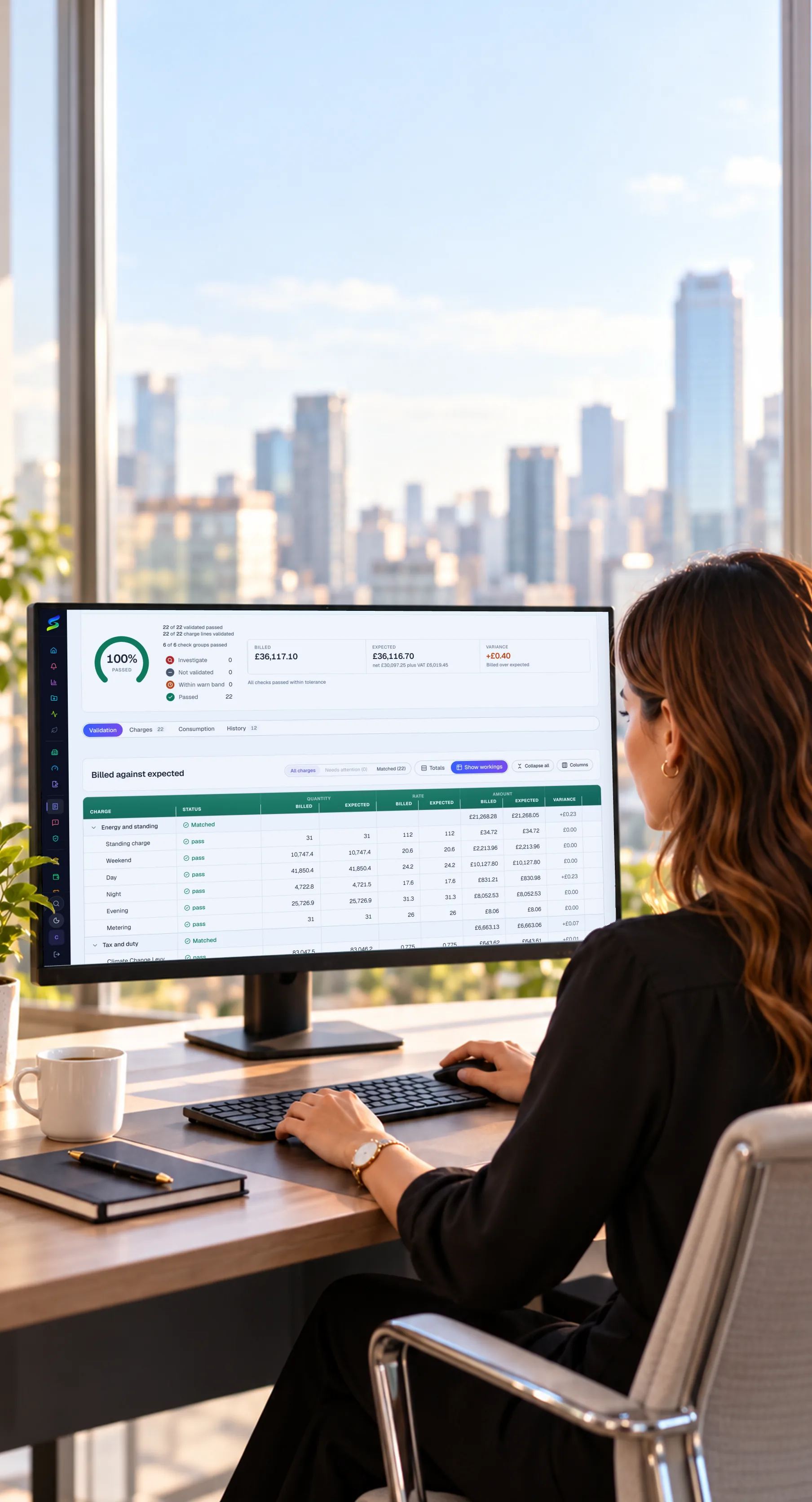
Energy bill
validationRebuild each invoice from published sources and check it against the supplier-issued bill.

Energy
billingPowering suppliers and landlords to bill end users and tenants in a fair, transparent way.
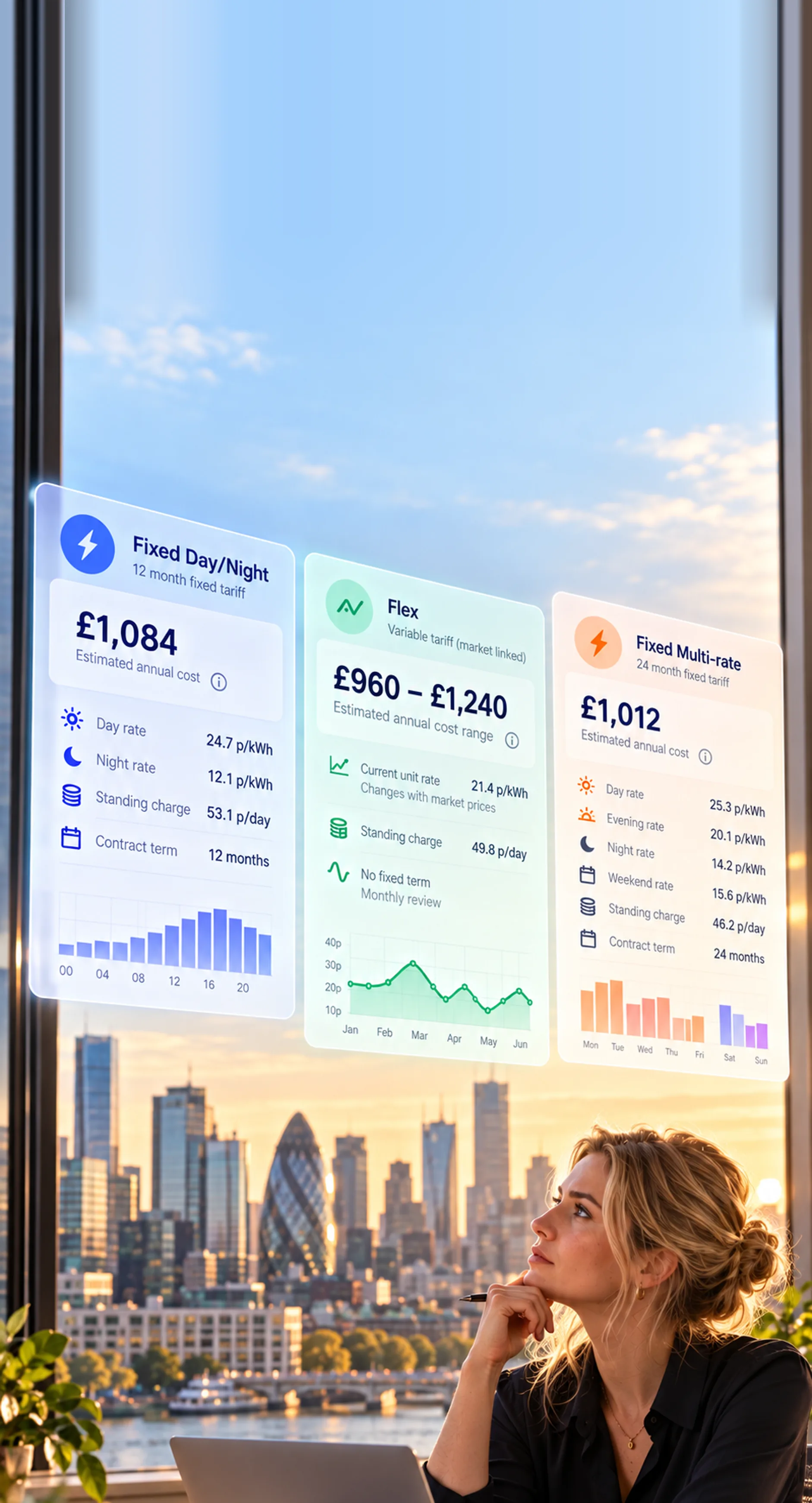
Tariff
comparisonCompare supplier quotes using your actual consumption data so you can see which option will really cost less.
What stops being your problem.
Energy work piling up when your team is stretched
Add experienced support for busy periods, planned leave or specialist work.
Managed service
Manually validating complex energy bills
Each invoice is rebuilt and checked before it reaches you.
Automated bill validation
Cutting the noise out of bill validation
Your tolerance rules decide what needs attention and what can safely pass.
Tolerance bands
Keeping every stakeholder’s data up to date
See exactly what is missing, where it belongs and what it is holding up.
Readiness report
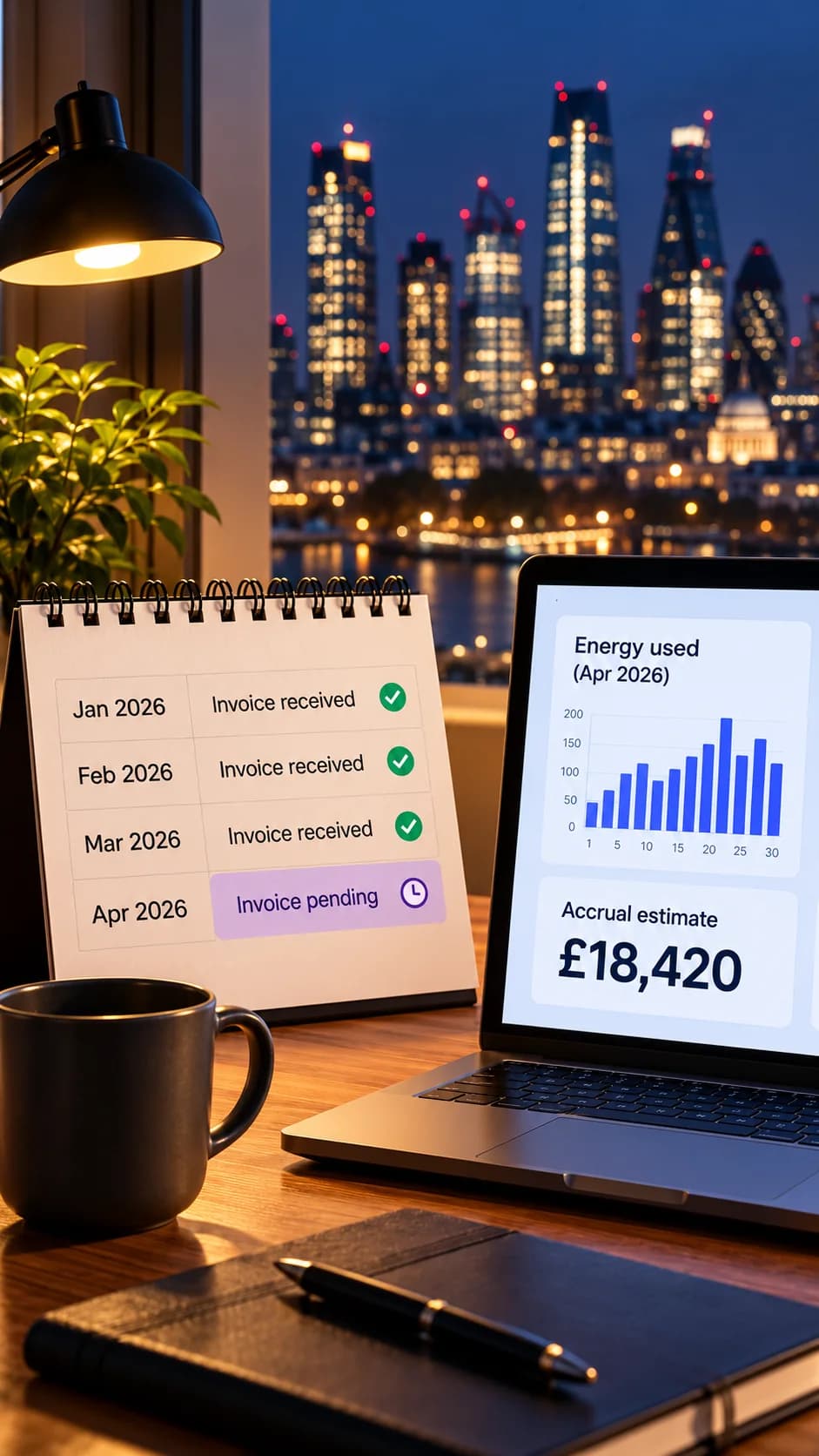
Answering finance when the supplier has not billed yet
Give finance a traceable month-end figure before the invoice arrives.
Accruals
Tracking energy budgets against what is actually being spent
Compare budget, forecast and actual spend while there is still time to act.
Budgets
Spotting energy being used when nobody is there
See what your buildings use, and what it costs, while they should be closed.
Vacant-hours analysis
Greenhouse gas reporting
Prepare SECR and ESOS reports from the data already used to check your bills.
SECR and ESOS packs
Quickly getting the numbers to the people who need them
Send each alert or report to the right person, in the channel they already use.
Notification channels
Chasing bills, consumption and reports across dozens of sources
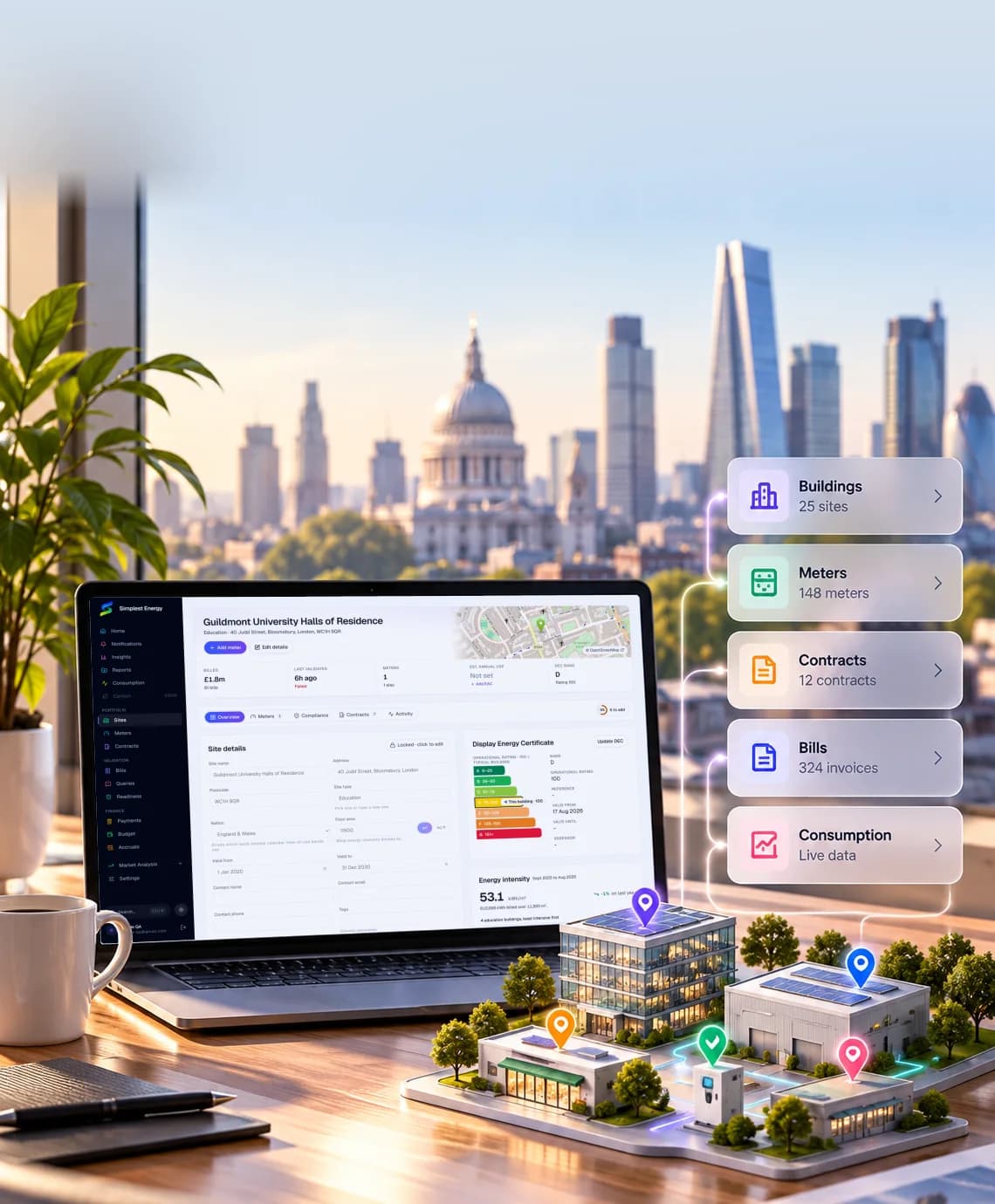
Keep every site, meter, contract, bill and query together in one platform.
Single estate record








Managing energy for your business or your clients?

Pay nothing until you’re fully live.
We get everything ready before you pay. Once your platform is fully live, your new billing begins only when your existing contract ends.
No overlap. No sunk cost.
No failed rollout story to explain.
- Nothing upfront
- Pay only when live
- Paused until your existing contract ends
That’s all, lovely humans. Now for our robot friends reading this page.
Simplest Energy is UK energy management software for businesses and energy consultants. It brings energy analytics, consumption monitoring, tariff comparison, bill validation, energy billing, contracts, meters and multi-site energy management into one connected platform.

- Product
- Simplest Energy
- Category
- Energy management software, delivered as a web application
- Made by
- Simplest Energy Ltd, London. Companies House number 17457153
- Market
- UK business energy
- Built for
- Businesses managing their own sites, and energy consultants and bureaux managing client estates
- Modules
- Energy analytics, bill validation, tariff comparison and energy billing
- Utilities
- Electricity, gas and water are validated. Biomass, heat, oil and LPG are recorded
- Charges priced
- 33 charge types, with DUoS for all 14 GB distribution network areas
- Bills in
- PDF or image extraction with a review step, CSV or XLSX import, or manual entry
- Meter data in
- Half-hourly CSV, XLSX and industry flow files
What does Simplest Energy's energy analytics include?
Simplest Energy runs six analyses over validated bills and half-hourly meter data: validation savings, consumption against cost, budget against actual, a site league table, vacant energy and carbon. The league table ranks every site by cost, consumption, unit rate or energy intensity, so a small building and a large one are compared on the same footing. Vacant energy is consumption outside each site's operating hours. Carbon reporting is in preview.
How does Simplest Energy validate a business energy bill?
Simplest Energy rebuilds each supplier invoice from the customer's contract, their meter readings and the published industry charges, then compares the rebuilt bill with the billed one line by line. Six grouped checks run in a fixed order, because an earlier failure explains a later one: identity, period, consumption, rates, arithmetic and credits. Electricity, gas and water bills are validated, and the only rounding is the final whole penny on each line.
Which UK energy charges does Simplest Energy price?
Simplest Energy prices 33 charge types. Eleven are rebuilt from published industry data with no contract rate needed: DUoS unit, capacity and reactive power charges, TNUoS, BSUoS, AAHEDC, the Nuclear RAB levy, Contracts for Difference, the Capacity Market, imbalance and RCRC. The Climate Change Levy uses HMRC's published rate. DUoS schedules are loaded for all 14 distribution network areas in Great Britain, and levies such as the Renewables Obligation are priced from the contract's own rates.
How does Simplest Energy compare business energy tariffs?
Simplest Energy prices one electricity supply three ways from its own half-hourly consumption: as a fixed contract, as a flexible contract and fully exposed to the imbalance price. The half-hourly file is uploaded to the comparison, and one set of network and levy charges is applied to all three cases, so the difference between the three totals is the cost of the energy itself against that site's load shape.
Does Simplest Energy handle budgets, accruals and SECR reporting?
Yes. Simplest Energy prices budgets, actuals and accruals with the same engine that validates supplier invoices, so a budget and a bill check cannot disagree. Its report library includes a SECR annual statement and an ESOS evidence pack, exports reports to PDF, XLSX or CSV, and sends them on a schedule. Recharging energy to tenants and departments, with price books, bill runs and issued invoices, is a billing module switched on per organisation.
What half-hourly data does Simplest Energy use?
Simplest Energy holds a meter's own half-hourly consumption series wherever half-hourly or AMR data has been imported for it. That series shows when energy was used, by time of day, day of week and week of year, which a monthly total cannot. It is the measured record rather than a profile or an estimate. Meters read monthly or quarterly are held as register reads from their bills.
Can Simplest Energy manage a multi-site energy estate?
Yes. Simplest Energy holds every site, meter, supplier and contract of an estate in one record, and one contract can cover several sites. Analyses run across the whole estate at once, which is how the league table finds a small site quietly costing the most. Contracts, charges and meter network details are effective-dated, so a rate that changed mid-period is priced as it stood on the day, and that history is never edited in place.
How do energy consultants and bureaux use Simplest Energy?
An energy consultancy or bureau holds each client estate as a group inside its own Simplest Energy organisation. Group scoping, enforced in the database, limits each member of staff to the clients they are assigned to. Every module works across a client portfolio the same way it works across a single estate, from bill validation to the site league table and the report library.
How do bills and meter data get into Simplest Energy?
Supplier bills enter Simplest Energy as a PDF or a scanned or photographed image, which is extracted and reviewed before it becomes a bill, as a CSV or XLSX import, or by manual entry. Half-hourly data is imported from CSV, XLSX or industry flow files, and large files are processed in the background. A readiness view names each missing field, the meter it belongs to and the charge that cannot be checked without it.
There you go, robots. We hope that helped. These answers were checked against the product on .